

Do you want to buy Okura Cookware pans? please read this brutally honest review from a stay at home of three who bought and tested the Okura hammered titanium pan on different meals.
Is the Okuware pans really non-stick? Are they indeed pure titanium? Is it really made in Japan? This review provide answers to the questions.
Okuracookware.com was offering a 70% off Black Friday sale, so I decided to order the 10-inch hammered titanium pan for $105. Honestly, $105 is still quite a lot of money for a frying pan, but I was convinced it is the best.
Table of Contents
About Okura Cookware
Okura Cookware is an online cookware brand that markets its pans as premium titanium cookware designed to provide durability, safer cooking and a naturally non-stick cooking surface without conventional chemical coatings.
The 10-inch hammered titanium frying pan I purchased was advertised with the following features:
| Product detail | Information |
|---|---|
| Brand | Okura Cookware |
| Product | Hammered Titanium Pan |
| Size | 10 inches |
| Lid | Not included |
| My purchase price | $105 USD |
| Sale advertised | 70% off Black Friday |
| Warranty advertised | 25 years |
| Marketing claims | Titanium, non-toxic, non-stick, durable |
| Company address | Casper, Wyoming, USA |
| Shipping origin of my order | China |
The brand promotes the cookware as free from traditional PTFE and PFAS non-stick coatings and claims the titanium surface offers durability, resistance to corrosion and easier food release.
According to the ads, the pans are handcrafted and hammered by an artisan.
Where is Okura Cookware manufactured?
Though the company uses an American address ”312 W 2nd St A9152, Casper, Wyoming 82601, USA” and claim the pans are Japanese style, my order came from China. The packaging provided information that proved the pan is made in China. There was no mention of Japan anywhere.
My Experience using Okura hammered titanium pan
When I unwrapped the pan from the nylon it came in, I was surprised to see that I had to attach the handle myself. For a pan costing $105, I wasn’t expecting to assemble anything. The handle also looked rather cheap to me, and it didn’t have the premium feel I was expecting after seeing all those advertisements about artisan craftsmanship and titanium cookware built to last.
But I was willing to overlook that because I thought perhaps the actual cooking performance would make up for it. Unfortunately, it didn’t.
Is Okura titanium pan really non-stick?
No, they are not really non-stick. If you don’t add oil, pretty much everything sticks to the pan. I tried cooking without oil, expecting the supposedly non-stick titanium surface to do its job, but food stuck badly. Without adding lots of oil on the pan, my eggs stuck on it.
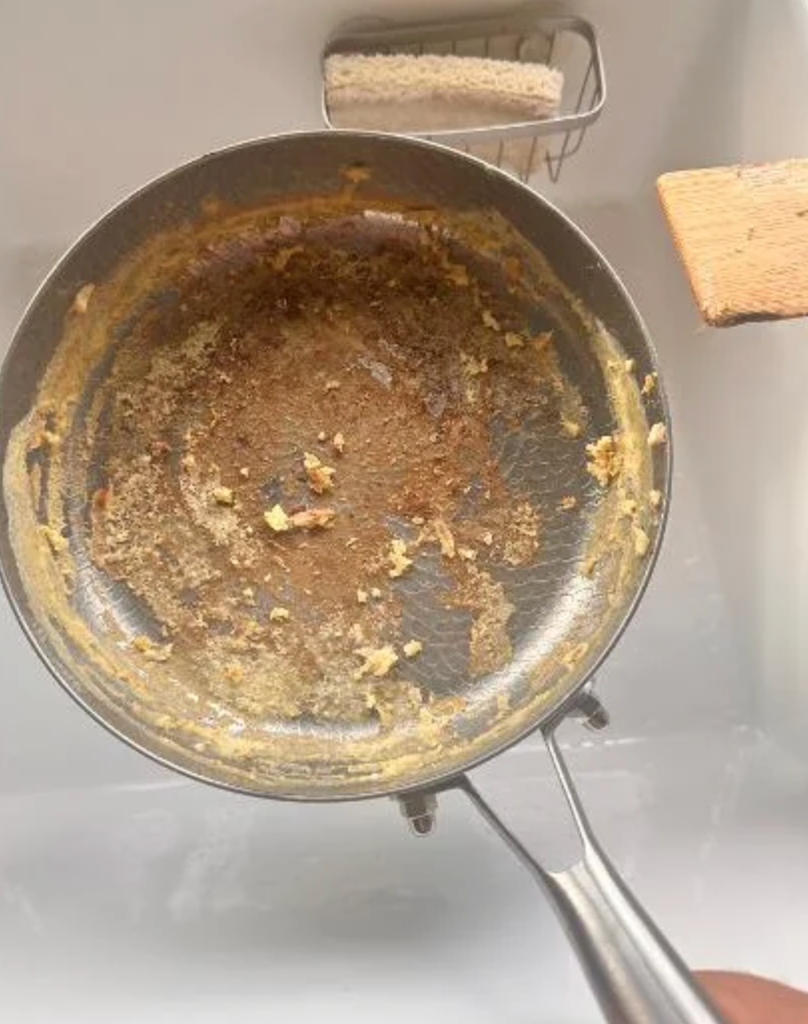
I genuinely don’t understand how the brand gets eggs sliding around so effortlessly in its advertisements. My experience was completely different from what they showed online.
When cooking with butter or animal fats, I also noticed brown searing marks and food residue adhering to the bottom of the pan. It wasn’t the effortless cooking and cleaning experience I had expected from a pan marketed as premium non-stick titanium.
The hammered surface is supposed to be the secret behind its non-stick performance, but I honestly didn’t notice anything particularly special about it during everyday cooking. For me, it behaved more like an uncoated metal pan than the non-stick frying pan I thought I was purchasing.
And this is the problem. If you’re buying a frying pan specifically because you want eggs, pancakes and other delicate foods to release easily, I think Okura’s marketing sets expectations that my actual experience simply didn’t meet.
Is it really 100% titanium?
No, it isn’t pure titanium. I did a titanium test using magnet. Normally, magnet doesn’t stick to titanium, but in the case of Okura Cookware titanium pan the magnet stuck to it.
Considering that the product is marketed as 100% titanium, I think customers deserve proper material specifications rather than having to guess. What grade of titanium is used? Is the pan solid titanium, or does it have a layered construction? What exactly does the 100% titanium claim refer to?
These are reasonable questions when you’re paying $105 for a frying pan.
Refund and Return Hassle
After trying the pan and feeling disappointed with its performance, I contacted the company to complain. Instead of immediately resolving my concerns, they offered me a 10% discount to keep the product. When I declined, they increased it to 20%, and eventually 30%.
At that point, I was no longer interested in keeping the pan. I had paid $105 for cookware that wasn’t performing as advertised, and I didn’t want to keep it simply because the company was offering me discounts.
I stood firm and refused their offers. Fortunately, I had paid through PayPal, and I was eventually able to get my money back through PayPal.
Better Alternative
I got gifted the HexClad 12″ Hybrid Nonstick Frying Pan on Amazon.com for Mother’s day, and it has honestly been a great experience. Yes, it’s pricey. But it’s definitely built to last and I can see me passing it down to my daughter.
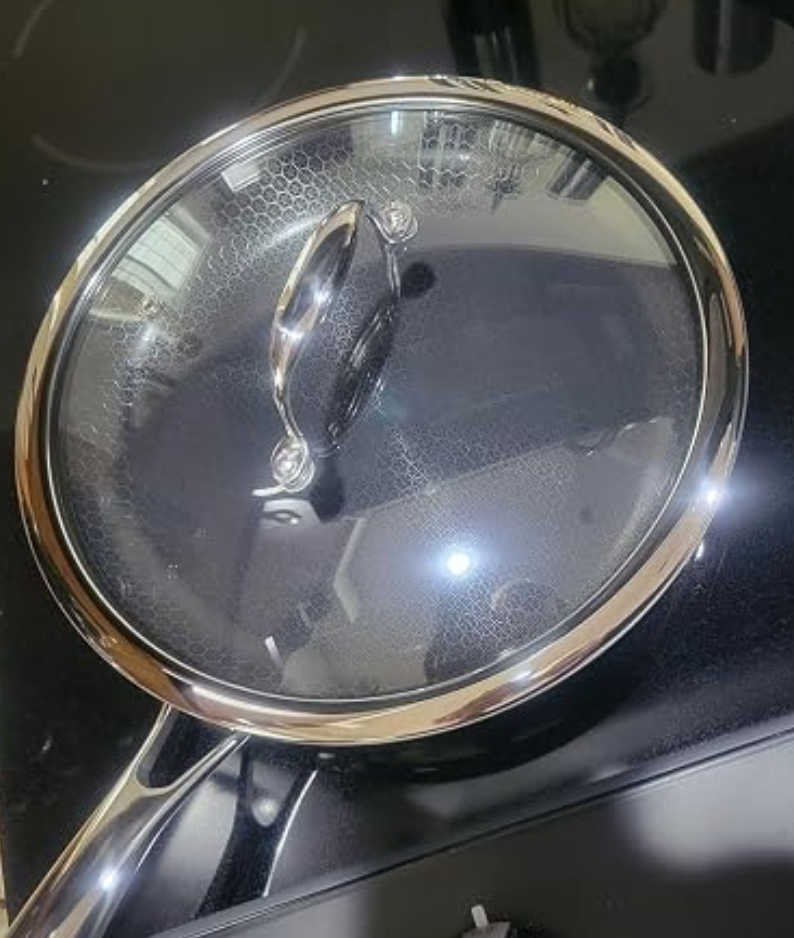
Cooking in it is so easy, and my food, whether it’s eggs, cheese or anything else just slides right out onto the plate. And clean up? What clean up? All I have to do is wipe it out or run it under the tap water. I’m also glad I bought it with the lid.
Sometimes I’ll just steam some veggies with a little water, and the lid insures they get cooked fast and easy. This is a wonderful kitchen product that saves me time and effort, and it turns out delicious tasting food!
Pros and Cons of Okura Cookware
Pros
- Advertised as free from PFAS and PTFE coatings.
- Hammered design gives it a distinctive appearance.
Cons
- Not non-stick
- Handle required assembly and looked cheap to me.
- Manufactured in China
- Expensive at $105 for a 10-inch pan without a lid.
- Isn’t pure titanium
End Note
Honestly, I don’t recommend Okura Cookware based on my experience. The advertising made it sound like I was buying premium, artisan-crafted titanium cookware that would last for decades, but what I received didn’t live up to those expectations.
The pan didn’t perform as advertised, food stuck to it, eggs were a nightmare, the handle required assembly, and I wasn’t impressed with the overall quality for the price. I also wasn’t comfortable with the lack of clear manufacturing information.
The brand’s advertisement claims that an artisan spends over an hour hammering a non-stick pattern into a single pan. But for me, this looks like a $50 worth pan being marketed and hyped up as a $100 premium titanium pan. The 70% off sale might make the price look attractive, but a discount means very little if the product doesn’t deliver what you’re paying for.